
If you are here, you might have been thinking about a career in cybersecurity but are not sure where to start. Or you are already working in IT and wondering whether a move into security makes sense right now. The answer to both questions is the same: there has never been a better time.
This guide walks you through exactly what the market looks like, what employers are hiring for, how to navigate the credential landscape, and what a long-term cybersecurity career in India can realistically look like. This covers everything from your first internship to a leadership position that commands ₹60 LPA and beyond.
The Scale of the Cybersecurity Job Market in India Right Now
There is no doubt that statistics of the cybersecurity job market in India for 2026 are astonishing. The country’s cybersecurity industry will reach around USD 35 million, creating over one million cybersecurity job openings in various sectors like entry level security operation jobs, senior cloud security architecture positions and others.
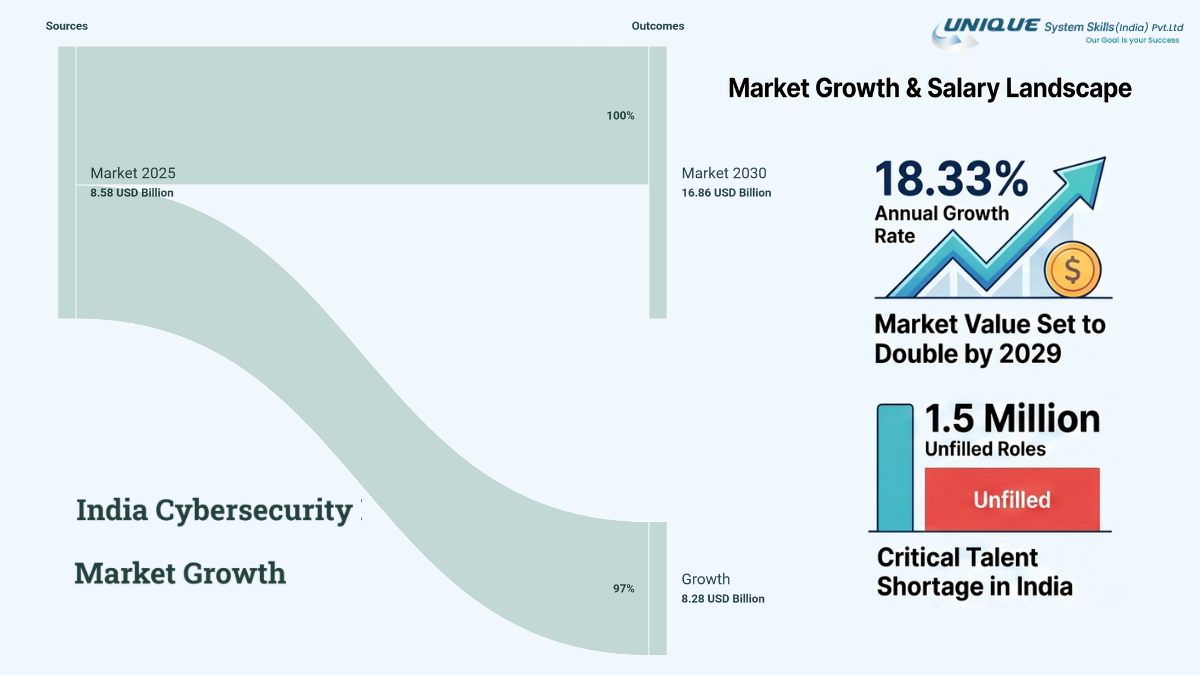
India Cybersecurity Market Growth
Thus, NASSCOM has predicted a shortage of 1.5 million qualified cybersecurity professionals in the country. This is a huge difference and NASSCOM has marked it as one of the top priorities of the technology companies market. Thus, we can say that the current cybersecurity job market in India has a structural shortage of qualified specialists in this field. It means that every qualified specialist who starts working in the field starts working in the environment where demand for his/her services exceeds supply. Moreover, the spatial distribution of the demand is changing. Bangalore is the place which has around 10% of all the national vacancies in the field of cybersecurity.
However, Pune, Hyderabad, and Delhi-NCR are closing the gap rapidly, driven by the expansion of IT parks, GCCs (Global Capability Centres), and fintech and healthcare technology companies that operate under strict data protection requirements. For professionals in these cities, the opportunity to build a strong cybersecurity career without relocating is increasingly real.
The Cybersecurity is not just one single beast spreading geographically, it consists of various types of security and different roles are build for each. Here’s a Map of the kind of roles:
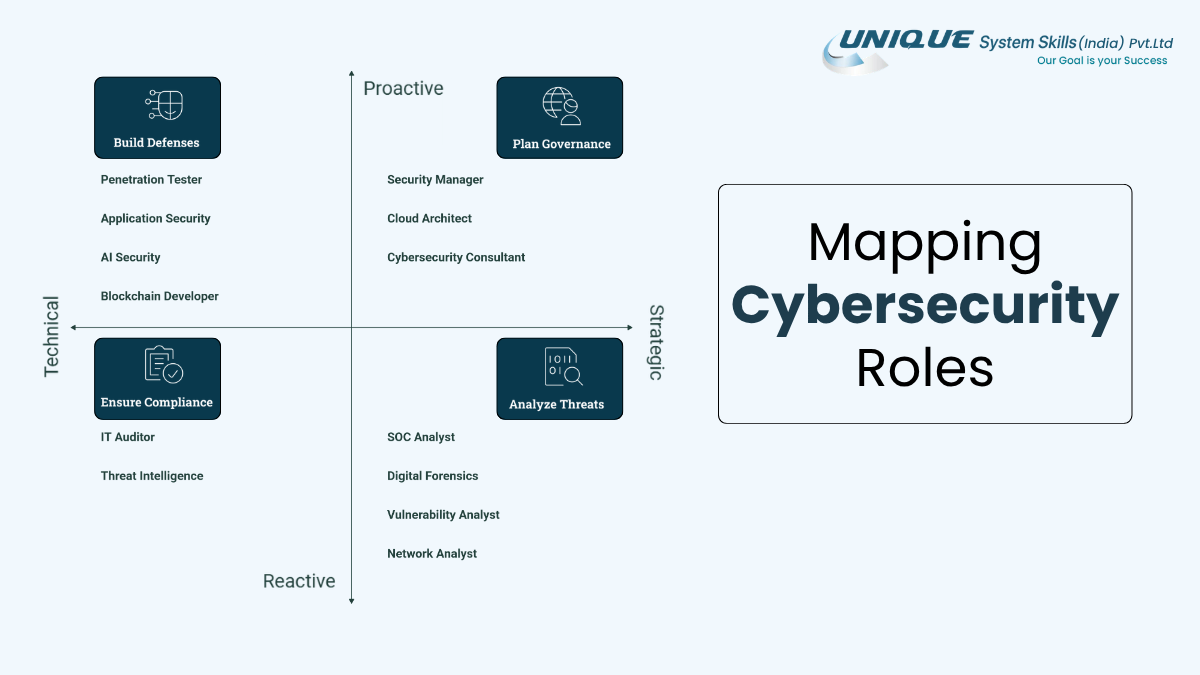
Mapping Cybersecurity Roles
What has changed, though, is the threshold for entry and understanding that shift is essential before planning any career move into this space.
What Cyber Security Objectives Are Driving the Hiring Surge?
The growth of the cybersecurity job market in India is not random. It is being driven by specific, board-level cyber security objectives that Indian enterprises are treating as strategic priorities in 2026. As per the report released by PwC’s Digital Trust Survey, 93% of executives in India are going to enhance their budget for cyber security in the current year. This investment in cyber security is supposed to have three major objectives:
- Prevention from AI-based spying
- Securing cloud-based infrastructure with the growing workloads moving to AWS and Azure.
- Implementation of Zero Trust security systems which consider no user or device as safe without verification of authenticity, even within the corporate network.
These cyber security objectives have a direct and practical effect on what kinds of professionals organisations are hiring. The days of the generalist security professional who understands a bit of everything are giving way to deep specialisation.
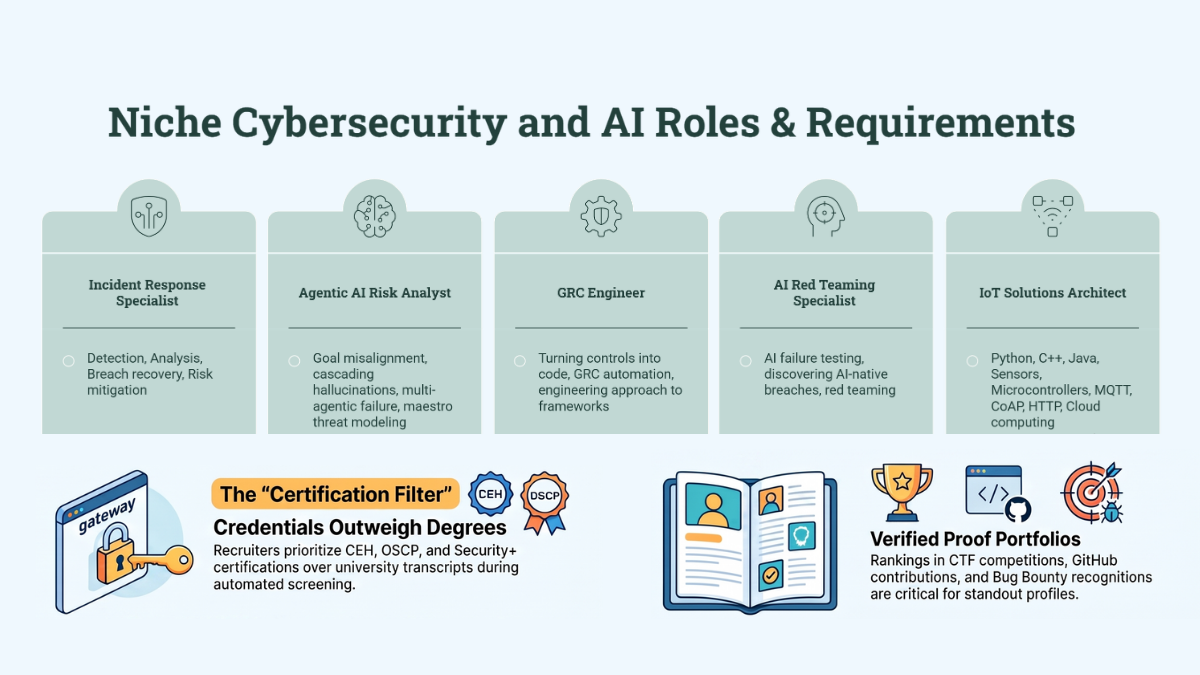
Niche Cybersecurity and AI Roles & Requirements
Equally important is the shift from following documented procedures to building and adapting security frameworks in real time based on the specific threat landscape an organisation faces. Professionals who develop this strategic, systems-level thinking are the ones who advance fastest and command the highest salaries in the Indian market. With the demand picture clear, the next challenge for most candidates is practical: how do you actually break into this market, especially without years of prior experience?
Cybersecurity Fresher Jobs and Internship Strategies
One of the most common and frustrating experiences for students and recent graduates entering the cybersecurity job market in India is encountering what we can call the ‘experience paradox.’ Cybersecurity fresher jobs that are explicitly advertised for entry-level candidates frequently list 1-2 years of prior experience as a requirement. This leaves newcomers wondering how they are supposed to gain experience without first being hired. This is a real structural challenge, but it is one that can be navigated systematically with the right combination of hands-on practice, formal credentials, and documented proof of practical skill.
The most effective first step is securing a cybersecurity internship through a recognised institution. Internships through government bodies like NCIIPC (National Critical Information Infrastructure Protection Centre) carry particular weight with Indian recruiters because they provide both documented experience and the implicit credibility of national-security-level work. Corporate internships at major IT services firms serve a similar function on a CV. Critically, a cybersecurity internship must generate specific, documented evidence of work completed including written vulnerability reports, security audits and incidents responded to.
Bug bounty programmes and Vulnerability Disclosure Programs (VDPs) on government and corporate domains can generate acknowledgement letters that serve as third-party proof of practical competence. Active GitHub repositories that show real security scripts, automation tools, or penetration testing write-ups provide the kind of documented evidence that distinguishes serious candidates from those who have only passed theoretical exams. With practical experience and portfolio building underway, the next dimension of cybersecurity fresher jobs strategy is the credential roadmap.
The Certification Roadmap from Google Cybersecurity Professional Certificate to Advanced Credentials
In the cybersecurity job market in India, certifications are the primary filter that determines whether an application is reviewed by a human being at all. Large IT services companies and MNCs use ATS (Applicant Tracking System), a software that screens for specific certification keywords before any recruiter sees the application. A candidate with strong hands-on skills but without “CEH” or “CompTIA Security+” explicitly listed on their CV will frequently be rejected before anyone evaluates their actual capability.
The Cybersecurity Fundamentals Certification Course, offered has emerged as a strong starting point for early-career candidates. It provides a basic understanding of security principles, Linux, and Python for security purposes, SIEM tools, and forms of attack detection which can help in practically and theoretically understanding this process. CEH (Certified Ethical Hacker) v13 from EC-Council and CompTIA Security+ are acceptable minimum qualification proofs for positions in traditional IT companies and multinational corporations. OSCP (Offensive Security Certified Professional) is the most desirable certification for penetration testing positions.
If job seekers are particularly aiming for cybersecurity roles in Google, Microsoft, or Amazon, then it is essential that the certificates related to cloud security are also acquired. AWS Security Specialty, Microsoft, Azure Security Engineer Associate, and Google Cloud Professional Cloud Security Engineer are respectively the certificates that demonstrate the multi-cloud expertise of the candidates. Understanding this stack is useful, but securing cybersecurity jobs in Google and tier-1 tech companies requires additional preparation that goes beyond credentials alone.
| Certification | Associated Roles or Sectors |
| CEH (Certified Ethical Hacker) (including v13) | Penetration Tester / Ethical Hacker, SOC Analyst, Information Security Specialist / Manager, Application Security Engineer, Cloud Security Engineer / Architect, Cybersecurity Consultant, Vulnerability Analyst |
| CISSP | Information Security Specialist / Manager, IT and Telecommunications, Cybersecurity Consultant, AI Security / Gen-AI Specialist, Information Security Engineer |
| Security+ | SOC Analyst, Information Security Specialist / Manager, Digital Forensics / Incident Analyst, Cloud Security Engineer / Architect, Cybersecurity Consultant, Information Security Engineer, Cybersecurity Services, Vulnerability Analyst, Network Security Analyst |
| OSCP | Penetration Tester / Ethical Hacker, Application Security Engineer, IT and Telecommunications, AI Security / Gen-AI Specialist |
| CISA | Information Security Specialist / Manager, Cybersecurity Consultant, IT Auditor |
| CySA+ | SOC Analyst, Digital Forensics / Incident Analyst |
| CSEP (Certified Security Engineer Professional) | Threat Intelligence Analyst, Security Engineer |
| SISA | IT Auditor |
| CASE | Application Security Engineer |
| Cellebrite Certified Operator | Digital Forensics / Incident Analyst |
| Certified AI Security Professional | AI Security / Gen-AI Specialist |
| Certified Web3 Compliance Expert | Blockchain Developer / EdTech |
| Certified Web3 Strategy & Growth Specialist | Blockchain Developer / EdTech |
| CHFI | Digital Forensics / Incident Analyst |
| CISM | Information Security Specialist / Manager |
| CPENT | Penetration Tester / Ethical Hacker |
| CSA (Certified SOC Analyst) | SOC Analyst |
| CTIA | Threat Intelligence Analyst |
| eJPT | Penetration Tester / Ethical Hacker |
| GSEC | Cybersecurity Services |
| PNPT | Penetration Tester / Ethical Hacker |
Targeting Cybersecurity Jobs in Google
Landing cybersecurity jobs in Google, Amazon, or Microsoft is an ambition pursued by many Indian professionals in 2026, and rightly so. These companies offer compensation packages, learning environments, and career trajectories that are genuinely exceptional. However, the gap between a standard security credential and a successful application to one of these companies is wider than many candidates expect, and understanding that gap is the first step toward closing it.
- Multi-cloud security expertise across AWS and Azure is a prerequisite rather than a differentiator.
- Deep familiarity with Zero Trust and the ability to design and evaluate Zero Trust implementations in complex enterprise environments is actively tested in technical interviews.
- Advanced threat intelligence capabilities, particularly around AI-native attack vectors and adversarial machine learning, are increasingly appearing in job specifications for senior roles at these companies.
- Candidates who have built experience in these specific areas through live lab environments, not just certification study, are the ones who move through technical screening successfully.
Getting into the cybersecurity job market in India also requires building genuine relationships within the security community through thoughtful LinkedIn engagement. The investment in these relationships pays dividends across every cybersecurity career stage that follows.
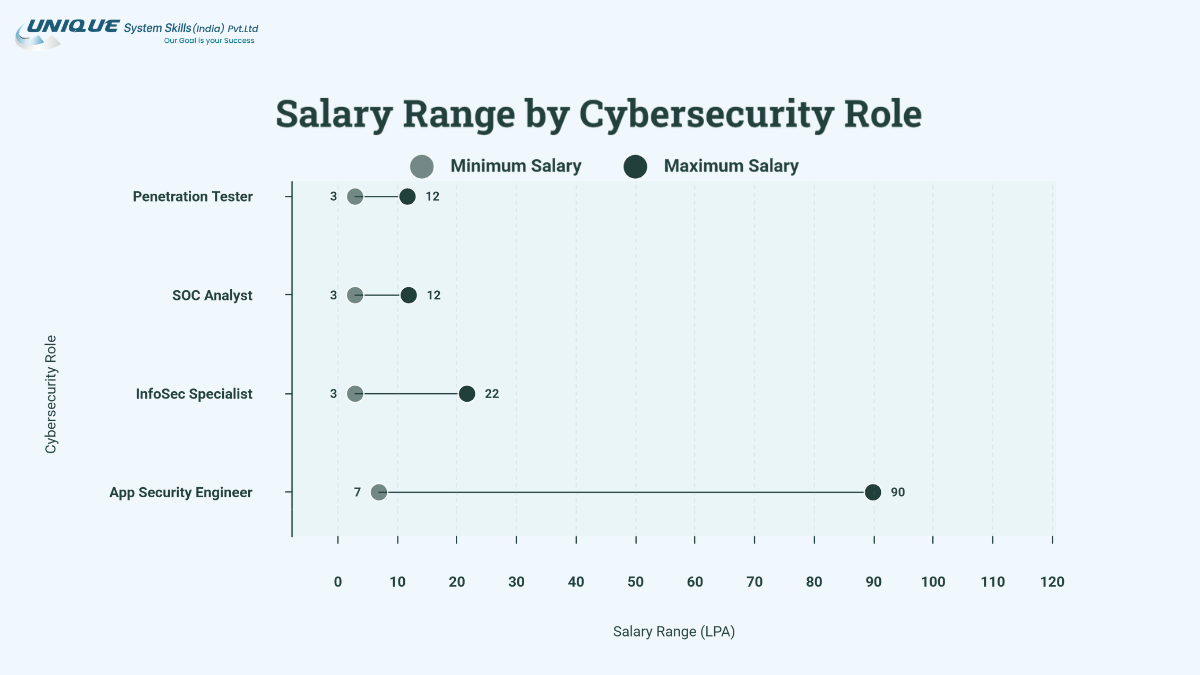
Salary Range by Cybersecurity Role
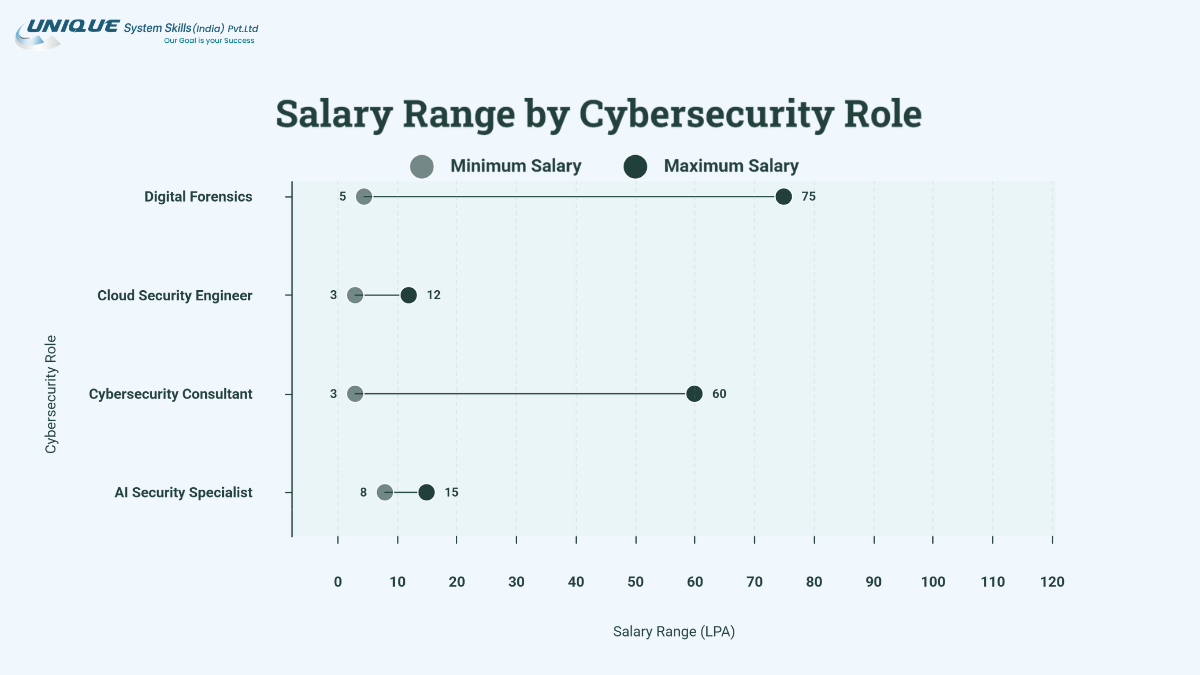
Salary Range by Cybersecurity
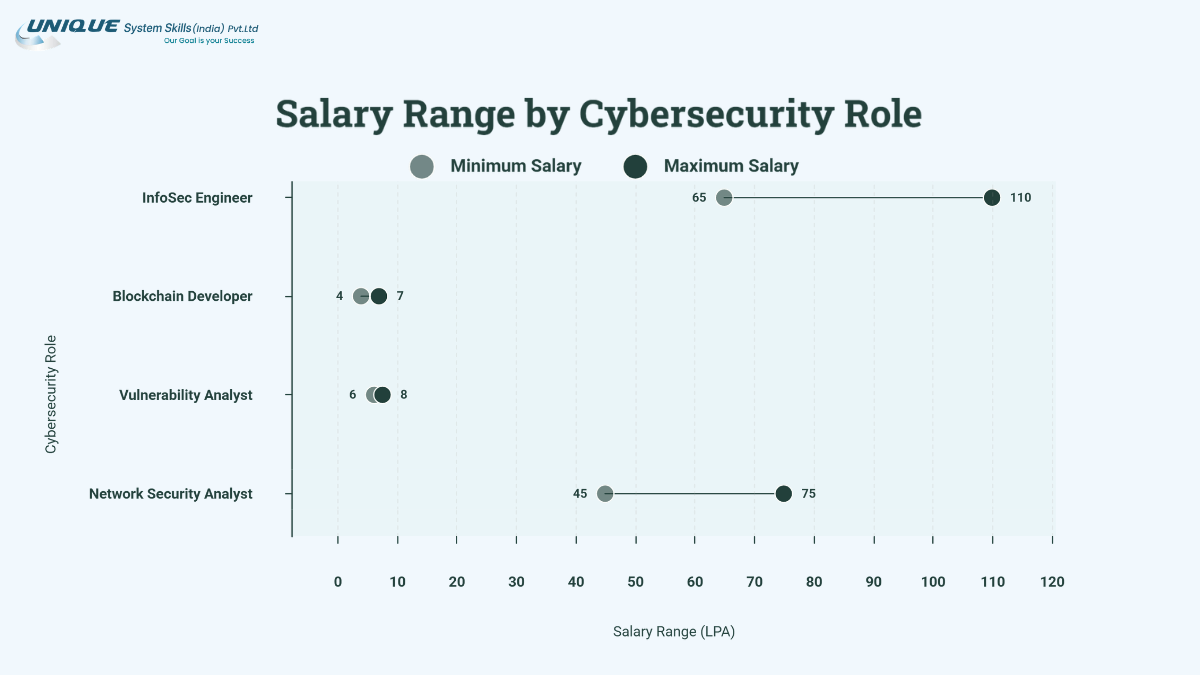
Salary Range
Salaries and Long-Term Cybersecurity Careers in India
What makes the cybersecurity job market in India impressive is the salary growth rate that professionals take advantage of by allocating resources to developing their skills on an ongoing basis.
The entry-level positions offer reasonable starting points:
- Application Security Testing and Information Security Testing specialists earn around ₹4 LPA
- Security Analysts earn around ₹6.9 LPA and Entry-level Penetration Testers earn around ₹11.8 LPA.
The salary acceleration happens at the mid-career stage:
- Systems Engineers and Network Administrators with good security knowledge earn around ₹6 LPA
- Cybersecurity Professionals, Information Security Consultants, and Network Security Consultants who can implement controls and communicate the risks obtain salaries of ₹7-10 LPA.
Senior strategic roles have the following income slabs:
- Cybersecurity Officer, Chief Security Architect command ₹25–35 LPA
- CISO-level compensation at major Indian enterprises can exceed ₹60 LPA in total compensation.
What drives this progression is the development of systems-level thinking and advanced specialisation in high-demand domains.
How Unique System Skills Prepares You for India’s Cybersecurity Job Market
In a talent market where 1.5 million positions remain unfilled due to a shortage of practically skilled professionals, the training partner a candidate chooses is the single variable most likely to determine their outcome. Unique System Skills (USS) has built its Cybersecurity programme specifically around the gap between what traditional education produces and what Indian enterprises actually hire for in 2026. The curriculum is tools-first such that learners develop hands-on mastery of Wireshark, Metasploit, Burp Suite, Splunk, and Kali Linux in live lab environments.
| Role or Sector | Required Skills & Technologies |
| Penetration Tester / Ethical Hacker | Ethical hacking, Bug bounty hunting, Tool development, CTF participation, VAPT, Wireshark, Metasploit, Burp Suite, Nmap |
| Security Operations Center (SOC) Analyst | Real-time threat monitoring, Incident response, Splunk, SIEM, Technical documentation, Analytical skills |
| Information Security Specialist / Manager | Information Security, Penetration Testing, Cloud Security, Digital Forensics, Contemporary security standards, Procedures, Methodologies |
| Application Security Engineer | Secure coding, Vulnerability assessment, AI-powered security analytics, Cloud-native applications, Software product security, Privacy compliance |
| Digital Forensics / Incident Analyst | Malware analysis, Forensic investigation, Threat Intelligence, Behavioral Analysis, Log Analysis, Python, Bash, Linux |
| Cloud Security Engineer / Architect | AWS, Azure, Cloud systems security, IAM, Cloud native security, Zero Trust enforcement, Identity management |
| Cybersecurity Consultant | Security strategies, Advisory programs, Problem-solving, Analytical thinking, Attention to detail |
| AI Security / Gen-AI Specialist | Python, Linux, Generative AI Security, DevSecOps, AI Platform Security, Model Manipulation Defense, AI pipelines, Agentic AI security |
| Information Security Engineer | Programming (Python, Linux/Shell), Firewalls, Forensic investigation |
| Blockchain Developer | Blockchain development, Smart contracts, dApp specialization, Java, Python, Cryptography, Distributed systems |
| Vulnerability Analyst | Kali Linux, Parrot Security OS, network traffic analysis, IDS/IPS tools |
| IT Auditor | Analysis, Discovery, Solution Implementation, Vulnerability Assessment, Risk mitigation, Audit/compliance logic |
| Network Security Analyst | Network management, threat analysis, IT/Healthcare/Finance network security |
| Threat Intelligence Analyst | Collects, analyzes, and disseminates information about cyber threats |
| Security Engineer | Designing, implementing, and maintaining security infrastructure and controls |
| IT Auditor | Analysis, Discovery, Solution Implementation, Vulnerability Assessment, Risk mitigation, Audit/compliance logic |
USS’s dual role as both a training institute and an active staffing company serving 100+ global clients gives it a real-time view of what hiring managers are screening for right now. This intelligence shapes the curriculum, the mock interview process, and the specific cyber security objectives that each programme addresses. Batch sizes are capped at 15 students, trainers are active security professionals, and globally recognised certifications through authorised partnerships with CompTIA and other bodies are woven throughout the programme.
Conclusion
The cybersecurity job market in India is growing at a pace that most other technology sectors cannot match, and the gap between the number of qualified professionals available and the number of roles that need to be filled has created a hiring environment where well-prepared candidates have genuine leverage.
Additionally, with Unique System Skills, for candidates targeting cybersecurity fresher jobs, the combination of live project experience, a documented portfolio, certification preparation, and direct referrals into USS’s hiring partner network addresses every stage of the journey including cybersecurity internships. With 17+ years of experience and 7,000+ professionals trained, USS is the training partner built for exactly the market that India’s cybersecurity sector has become.